Ikebana: Exquisite Japanese Flower Arrangements


While flower arrangement for many people in the West consists of symmetrically arranging flowering plants in a vase, Japanese Ikebana (literally 'flowers kept alive') is a lot more complex.


While I was in Japan, I attended ikebana classes, and I really enjoyed them.

Ikebana is the art of arranging flowers aesthetically. One tries to represent the three elements sky, earth, and mankind in a well balanced relation.


Traditional ikebana, called kado ("the way of the flower"), developed in the 16th century. There are many different schools of traditional ikebana. In addition, modern styles of ikebana (avant-garde ikebana) have evolved. Some of these styles use glass, iron, and other materials instead of flowers.


There are many schools, of which the most popular are Ikenobo, Sogetsu and Ohara. There are also different styles depending on the school and the plants and vase used.


Ikenobo


Ikenobo


Ikenobo


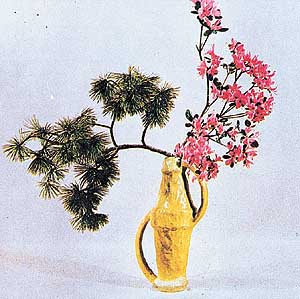
Ikenobo is the oldest school of ikebana, founded by Buddhist priest Ikenobo Senkei in the 15th century. He is thought to have created the rikka (standing flowers) style. This style was developed as a Buddhist expression of the beauty of nature, with seven branches representing hills, waterfalls, valleys and so on arranged in a formalized way. The present 45th-generation head of the school is Ikenobo Sen'ei. The school is based in the Rokkakudo temple in Kyoto, believed to have been started by Prince Shotoku. Among the priests and aristocrats, this style became more and more formalised until, in the late 17th century, the growing merchant class developed a simpler style, called seika or shoka. Shoka uses only three main branches, known as ten (heaven), chi (earth) and jin (man) and is designed to show the beauty of the plant itself. Another old form of ikebana is nageire, used in the tea ceremony.


Sogetsu


Sogetsu


Soketsu


Ohara


Ohara


Ohara


Naigere


Naigere

The first of the modern schools was formed when Ohara Unshin broke from the Ikenobo school in the late 19th century. The Ohara school generally uses moribana (piled-up flowers) in a shallow, flat container. The school was started at a time when Western culture was heavily influential in Japan and the moribana style made good use of Western plants. But it was still a formal style. 


Moribana


Moribana


Influence from the artistic movements of the early 20th century led to the development of jiyuka (free-style) arrangement. Despite all the changes, ikebana was still only for the upper class.


Jiyuka


Jiyuka

In the 1930's and then more so in the postwar period, interest in ikebana became much more widespread. Ikebana schools opened which attracted people of all social classes. During the occupation, many wives of US servicemen took up the art and later helped it spread abroad. Led by Teshigahara Sofu, founder in 1927 of the Sogetsu school, zen-eibana or avant-garde ikebana introduced all kinds of new materials, such as plastic, plaster and steel.


My first ikebana arrangement


My classmates in the ikebana class

Today, there are about 3,000 ikebana schools in Japan and thousands more around the world. The Ikenobo school alone has some 60,000 teachers worldwide. Ikebana is practiced by about 15 million people in Japan, mostly young women.
Ikebana can be roughly divided into two styles - the moribana shallow vase style and the nageire tall vase style. The Sogetsu school uses a series of kakei (patterns) for each style so that even the beginner can quickly create their own arrangements. As an example, let's look at the moribana Basic Upright style.


Kenzan is the spiked meta holder used in the ikebana arrangements


There are different kinds of kenzan


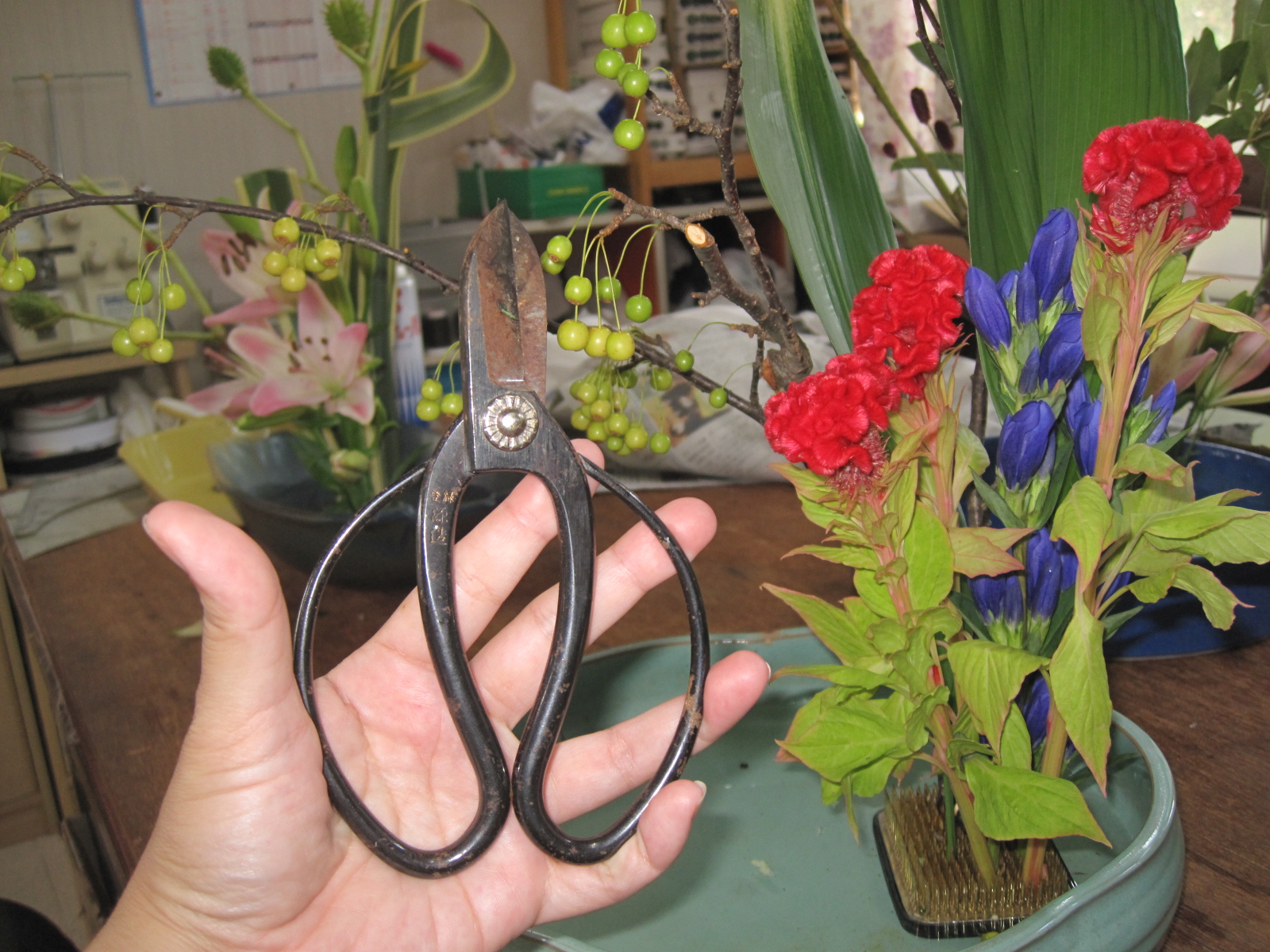
Special scissors are used in ikebana

The shushi are the three main branches - the shin (truth) branch, the soe (supporting) branch and the hikae (moderating) branch. The arrangement of these branches and the kenzan or spiked metal holder are drawn in a simple diagram, called a kakeizu. The kakeizu shows a frontal and overhead view of the arrangement. After examining the kakeizu, suitable branches or flowers are chosen for the shushi and trimmed if necessary. The stems are cut to correct lengths according to set formulae. The kenzan is placed in the vase and just covered with water. The sushi are fixed to the kenzan in order and according to the kakeizu. Jushi or short supplementary stems are added to support the shushi and give depth to the arrangement. Finally, the composition is examined and any finishing touches applied.

History Of Anime in Japan


Many people in the U.S.  probably heard of cartoons like Sailor Moon, Dragonball Z, Voltron, Gundam Wing, Speed Racer, Digimon, and the ever so popular Pokemon; Famous cartoons that have bizarre character designs: female characters with beautiful round eyes, hair that is incredibly big, and gorgeous figure and physique.  Male characters would usually have enormously huge muscles (as seen in Dragonball Z and GT), powerful bodies and maybe, on occasion, have gigantic robots as seen in cartoons like Robotech and Gundam Wing.
Where did all these cartoons come from?  To find the answer one must look no further than in Japan, the birthplace of Japanese animation, the main source for all of this madness.
Japanese animation, also known as anime (pronounced "ani-may"), is a popular form of animation in Japan which is quickly spreading in the U.S.  The major difference between anime and American cartoons is that unlike American cartoons, which are only watched by children, anime is popular among the Japanese adults and is watched by millions.  The audience is not merely directed to children but to teens and adults as well.  The same applies to Japanese comics known as manga.
In order to understand anime and its invasion into the US, a look into its history would be most appropriate.  The best place to start is around World War II, since that was the time when the anime and manga (Japanese comics) industry evolved significantly. 


Voltron


Bleach

During World War II the entire Japanese nation was mobilized.  The people were forced to conform to the government's demands or pay the ultimate price.  According to Frederik Schodt's book, Manga Manga: The World of Japanese Comics, those who failed to cooperate were punished by "preventive detention, bans on writing, and social ostracism, while those who recanted were rewarded with rehabilitation programs and support from the community...artists who had spent most of their lives criticizing the government did an about-face and offered wholehearted support to the militarists"  (Schodt, 55). 


Naruto


Ruroni Kenshin

Around 1940, many organizations for artists and cartoonists were formed.  Among them were the New Cartoonists Association of Japan (Shin Nippon Mangaka Kyokai) and the New Cartoonists Faction Group (Shin Mangaha Shudan).  During that time, the government used the few remaining cartoonists, who were not banned from working or who were not in the army, to influence the people through their artwork by creating comic strips filled with propaganda to use against the nation's enemies.  

Animation in the US:

In another part of the world, an influential artist who went by the name of Walt Disney was struggling as a cartoonist.  Long before Mickey Mouse, he started out with Alice's Wonderland and Oswald the Lucky Rabbit in the 1920s.  Then on November 16, 1928, Mickey Mouse was born and became an instant hit in the US.  Disney decided to work on other projects and started on an animated feature film called Snow White and the Seven Dwarfs.  The film, released in 1937, was a spectacular hit.  Things went smoothly for the Disney Studio until World War II came along.  Nevertheless, Disney continued to work and released Pinocchio and Fantasia in 1940.  Although the two were technical masterpieces, the studio was losing a great deal of money since they were losing the foreign market due to the war.  Disney then released Dumbo,on a very limited budget, in 1941 and Bambi in 1942.  As a result of releasing many expensive and costly films during the war, Disney began to diminish in influence.


Pinocchio


Dumbo

During the war, Walt Disney Studios released two more films Saludos Amigos and The Three Caballeros in South America.  Throughout the war, Disney concentrated on making propaganda and training films for the military.  After the war, Disney Studios struggled to make it back to top as they released several "package" films containing groups of short cartoons packaged together.  Among these films were Make Mine Music and Melody Time.  By 1950, Disney Studios regained success with the live action film, Treasure Island, and the animated feature, Cinderella.
With all the success, Walt Disney felt there was still something he had not yet accomplished.  It was not until he found his intriguing attraction to amusement parks that pushed him to build his own theme park, one that children, parent, and people of all ages could enjoy.  Thus after many years of planning, construction, and development, Disneyland was built in 1955.  It became a monumental park that brought visitors from around the world.
Though Disneyland kept Disney rather busy, he, along with his studio and team, continued releasing quality entertainment.  Disney released 20,000 Leagues Under the Sea, The Shaggy Dog, the popular TV series Zorro, and Mary Poppins.  Unfortunately, the 1960s brought the end of an era: in December 15, 1966 Walt Disney died.  However, the Walt Disney Studios managed to survive under the plans that Walt left behind and under the guidance of his brother Roy Disney.  Disney remained under Roy's leadership with further releases of The Jungle Book in 1967, The Love Bug in 1969, and The Aristocrats in 1970.  By 1971 Roy Disney died and for the next decade, the company was led by a team who was originally trained by the Disney brothers.  The team included Card Walker, Donn Tatum, and Ron Miller.
The Master Brings Life to Animation:


Osamu Tezuka


Back in Japan, after World War II, a young aspiring artist named Osamu Tezuka became a cartoonist and released his first work Shintakarajima (known in English as "New Treasure Island").  As a child, Tezuka was a fanatical fan of Walt Disney's early animations.  Many were impressed by Tezuka's original style.  However, it was not until Tezuka released his ultimate work Tetsuwan Atomu (Astro Boy) that he achieved success; he was pronounced "the Father of Manga and Anime".


When Tezuka made a name for himself in the industry, he managed to establish his own production company in 1962.  He formed Mushi Productions, where he released his best work, Astro Boy.  With Astro Boy, Many recognized Tezuka's original style and approach that was new to the entire industry.  The style of his illustrations and characters came from French and German cinema.  His characters exploded with life and emotion, and his stories would unfold themselves on hundreds of pages.  By 1963, Astro Boy crossed international borders and was premiered on NBC stations all over the US and was still successful with American audiences.


Jungle Taikei  Kimba the White Lion


Jungle Taikei  Kimba the White Lion

After the success of Astro Boy, Tezuka released another work, Jungle Taitei (Kimba the White Lion).  There was much controversy in the past about this anime after Disney released a similar version with the movie The Lion King with Simba as the main character.  Although Disney denies this, many believe that Disney stole the anime and recreated it with their own version.

DIFFERENT TYPES OF ANIME

There are different ways you can categorize them.

By Genre:

1) Action/adventure: martial arts, weapons, battles, etc.
2) Drama: character developments, emotional, relationships
3) Game Based: based on game, card game, or board game such as yu gi oh
4) Horror: darker or supernatural themes
5) Sci-Fi: futuristic, science, technology
6) Progressive: extremely stylized art films

Or by their Demographic, Who they are towards:

1)Shojo- young girls


Fushigi Yuugi


Vampire Knight


Kimi no Todoke


Rosario Vampire


Fruits Baskets

2)Shonen-- young boys


Naruto


Pokemon


Saint Seiya


Full Metal Alchemist


3)Seinen--teenage boys or young mal


DEATH NOTE


GANTZ


TRINITY BLOOD


BLOOD PLUS


JIGOKU SHOUJO


4)Josei-- young women


PARADISE KISS


NANA


NODAME CANTABILE


BLUE


KIMI WA PETTO


5) Kodomo-- children, little kids 


DOREMON


ANPANMAN


BARBAPAPA


HELLO KITTY


HAMTARO